
Every HVAC contractor knows the feeling. It’s the first week of June in Phoenix. The temperature hits 108°F. Your phone starts ringing at 7am and doesn’t stop. Three techs are already on jobs. You’re driving to a fourth. And somewhere in that chaos, calls are going to voicemail.
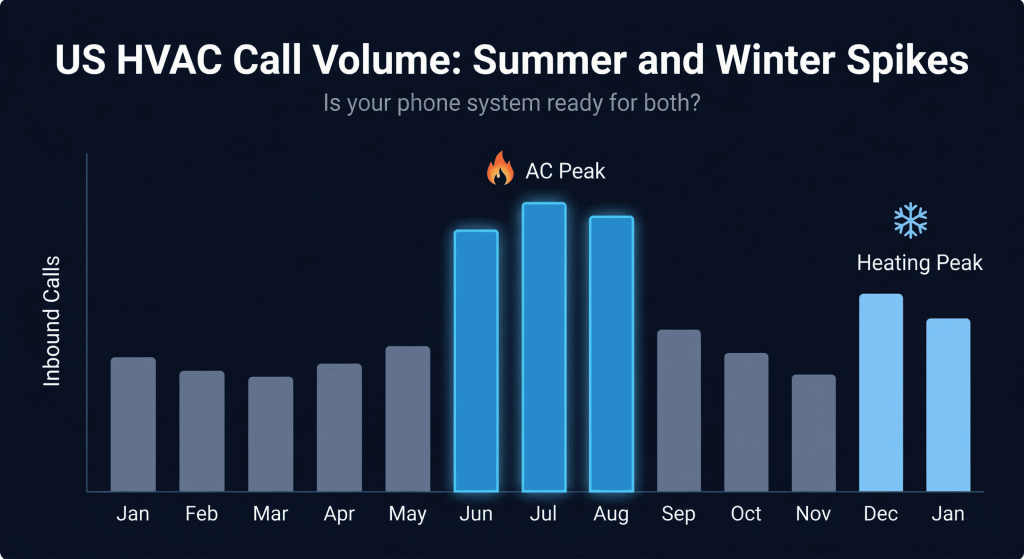
That’s peak season. And for most small HVAC shops, it’s both the best and worst time of year, the most revenue opportunity and the most revenue lost simultaneously.
The contractors who win peak season aren’t just the ones who work hardest. They’re the ones who prepared before it started.
Here are five things worth doing now, before the rush hits.
1. Find out how many calls you’re actually missing
Most HVAC contractors have no idea what their real call answer rate is. They know they’re busy. They know some calls go to voicemail. But they don’t know the number.
Before peak season, spend one week tracking every incoming call. Note which ones were answered live, which went to voicemail, and which rang out with no answer at all. If you have a phone system with call logs, pull the data. If you’re on a personal cell, go through your missed calls for the last 30 days.
What you’ll likely find is uncomfortable. Contractors who do this exercise for the first time regularly discover they’re missing 20–40% of their calls during normal operating hours, and a much higher percentage after 6pm and on weekends. During peak season when call volume spikes, that miss rate tends to climb.
You can’t fix what you haven’t measured. Start here.
2. Separate emergencies from routine calls before they hit your dispatch
This is the step most HVAC businesses skip entirely, and it costs them the most during peak season.
When a family’s AC stops working at 9pm in July, they are not calling to schedule a tune-up. They are calling in a panic. They need to know someone is coming. If they get voicemail, they immediately call the next contractor on their list. If someone answers and takes down what is actually happening, they stay with you.
The problem is that during peak season, your dispatcher or answering service is handling every call the same way. Routine service requests, maintenance plan reminders, new customer inquiries, and genuine emergencies all go into the same queue. The emergency family calling at 9pm waits behind the customer asking about a tune-up price.
The fix is a triage step, human or otherwise, that catches the emergency signals before the call joins the queue. “No AC in Phoenix in July,” mentions of elderly or young children in the home, calls after 8pm during a heatwave. These are the signals worth acting on the same night, rather than leaving for a next-morning callback.
Thermoi’s AI (Sara) answers every one of those calls instead of letting them ring out, and captures what the caller actually said. Thermoi does not do the triage itself, so the sorting is still yours, but you are sorting real calls with real transcripts rather than guessing from a voicemail count.
3. Pre-schedule your maintenance plan customers before peak season starts
If you run a Comfort Club or any form of maintenance agreement, peak season is the wrong time to be scheduling those visits. Your techs are already slammed. Adding maintenance appointments on top of emergency dispatch during a heat wave creates delays, rushed work, and unhappy customers.
The solution is to front-load your maintenance schedule. Starting in April or early May, reach out to all maintenance plan customers and get their summer tune-ups on the calendar before temperatures spike. Offer a small incentive for early scheduling: a filter replacement, a priority service window, a modest discount.
This does two things. First, it reduces the call volume hitting your dispatch during peak weeks because a chunk of your customers are already handled. Second, it gives you cleaner intel on which systems are likely to fail during the summer, you can flag the ones in poor condition during the pre-season tune-up and have that conversation with the homeowner before they become an emergency call at midnight.
Maintenance plan customers who get a pre-season call feel cared for. Those who have to chase you for their annual service feel like an afterthought. The difference shows up in your renewal rates.
4. Audit your on-call rotation before you need it
Here’s a peak season scenario that plays out at HVAC shops every summer: an emergency call comes in at 10pm, the answering service takes the message, the on-call tech gets the message at 10:30pm, calls the customer back at 10:45pm, and discovers the customer already hired someone else at 10:15pm.
That 45-minute window is the gap that kills after-hours revenue.
Before peak season, review your entire on-call process end to end. How does an after-hours emergency call reach your on-call tech? How many steps are in the chain? How long does each step take? Where are the handoff failures?
The benchmark to aim for is under 10 minutes from call to on-call tech notification. If your current process takes longer, and most do, map the steps and find the delays. Common fixes include direct SMS alerts rather than message relay through an answering service, a dedicated on-call line that bypasses the main number, and a backup tech who automatically gets notified if the primary doesn’t respond within five minutes.
Air-Rite’s own approach, which came up during a demo, is to page their on-call techs before 10pm and call them directly after that. That’s the right instinct. The gap is that the handoff still goes through a human chain. An assistant that answers the call takes one link out of that chain, the message relay, so what reaches you is the caller’s own words rather than a note taken second-hand. Who gets paged after that, and how quickly, is still your chain to fix.
5. Set customer expectations clearly, before and during the call
During peak season, even the best HVAC operations run behind. That’s not a failure, it’s physics. You have a fixed number of techs and more demand than capacity.
What determines whether a delayed customer leaves a bad review or a patient one is almost entirely about expectation setting. A customer who is told at 9pm “we have availability tomorrow morning between 8 and 11, I’m booking you right now” is far less frustrated than a customer who gets “someone will call you back” and then waits without hearing anything.
Two things to implement before peak season:
First, give your call handlers (human or AI) specific language for communicating wait times honestly. “We’re extremely busy this week, the earliest I can get someone to you is Thursday morning. Would you like me to book that?” is better than vague reassurances. Customers respect honesty. They don’t respect being strung along.
Second, send automated confirmation and reminder messages for every booked appointment. An appointment reminder the morning of the visit, with the technician’s name and a rough arrival window, reduces no-access jobs and makes you look organized even when you’re stretched thin.
Thermoi does not send these today. Sara agrees the time out loud on the call and reads it back, so the homeowner hangs up already knowing the window; reminder messages are on the roadmap rather than in the product. By the time your tech arrives, the customer has been touched three times and knows exactly what to expect. That’s the experience that generates five-star reviews even during the busiest weeks of the year.
The prep that pays off most
Of the five items above, the one with the highest return is fixing your emergency triage and on-call notification speed. Routine calls can wait. Emergency calls cannot. Every minute between a homeowner’s AC failure and your on-call tech’s notification is a minute during which they’re calling your competitors.
Peak season is when HVAC businesses are made or broken. The contractors who do the prep work in April and May: auditing their call handling, front-loading maintenance schedules, tightening their on-call chain, capture the summer revenue that funds everything else. The ones who wait until June to think about it spend the whole season scrambling.
Start now. Peak season in Phoenix is already on its way.