
Most HVAC contractors know they’re missing calls. What they don’t know is the number.
Not the vague sense that some calls slip through during busy periods, but the actual dollar figure attached to the calls that rang out, hit voicemail, or came in at 10pm on a Friday when nobody was available to answer. That number, when contractors calculate it honestly for the first time, is almost always larger than they expected.
This post walks through how to calculate it for your business, and what the realistic options are for reducing it.
Why missed calls are an HVAC-specific problem
In most industries, a missed call is an inconvenience. In HVAC, it’s a lost job.
Here’s why: when a homeowner’s air conditioning fails on a 100-degree July afternoon in Phoenix, they don’t send one inquiry and wait patiently. They call three contractors in a row and book with the first one who answers. The contractors who didn’t answer never find out they lost the job. There’s no follow-up, no voicemail callback, no second chance. The customer is already booked with someone else.
This winner-takes-all dynamic means missed calls in HVAC carry a cost that doesn’t exist in most other service businesses. The call doesn’t go into a queue to be answered later. It walks straight to your nearest competitor.
The problem is worst at exactly the moments when call volume is highest: peak summer and winter weather, evenings and weekends, and any period when all your techs are simultaneously on jobs. These are the highest-value calls (emergency jobs, system replacements) arriving at the exact moments your phone handling is at its weakest.
How to calculate what missed calls are costing your business
Rather than using industry averages, which vary wildly depending on business size, market, and service mix, the most useful thing is to calculate your own number.
Here’s a simple framework:
Step 1. Estimate your weekly call volume. If you have a phone system with call logs, pull the last 30 days. If not, think about how many calls you personally receive on your cell on a typical weekday, then factor in evenings and weekends. A small HVAC shop serving a single market typically receives between 30 and 100 calls per week depending on season.
Step 2. Estimate your miss rate. This is the hard one to be honest about. Count only calls answered live, not returned voicemails and not next-day callbacks. If you have two techs out on jobs from 8am to 5pm and nobody in the office, your miss rate during those hours is effectively 100%. Most small shops, when they add up evenings, weekends, and busy daytime periods, find their real miss rate is somewhere between 25% and 50% of total weekly call volume.
Step 3. Apply your average job value. For a service call, this might be $200 to $400. For a system replacement lead, it could be $5,000 to $15,000. If you handle a mix, use a blended average. A reasonable middle figure for a general HVAC service call is $350 to $500.
Step 4. Multiply. Weekly missed calls × average job value × 4 weeks = monthly missed revenue.
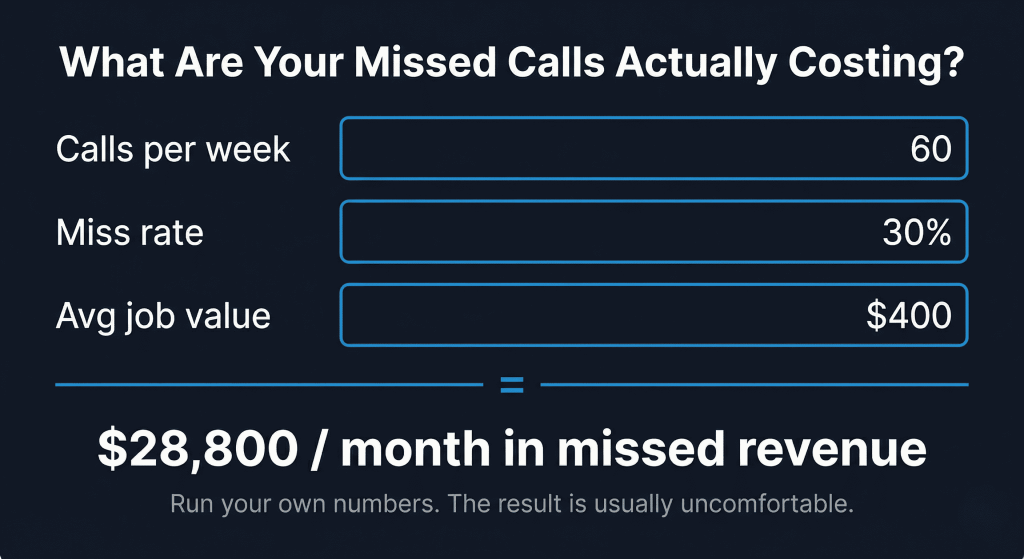
A shop receiving 60 calls per week with a 30% miss rate (18 missed calls/week) and an average job value of $400 is missing roughly $28,800 per month in potential revenue. That’s not a worst-case scenario. It is a conservative estimate for a mid-size single-market operation.
Run your own numbers. The result is usually uncomfortable the first time you see it.
If you would rather not do the arithmetic by hand, the ROI calculator on our pricing page runs the same math with sliders for call volume, answer rate, and average ticket.
Where the missed calls actually come from
Understanding the pattern matters because not all missed calls are equal, and the most expensive ones tend to cluster in specific windows.
After-hours and weekends. The majority of HVAC emergencies happen outside business hours. An AC that’s been struggling all day often fails completely at 6pm when the homeowner gets home. A heating system failure in January rarely announces itself at 10am on a Tuesday. If your phone coverage ends at 5pm, you’re unprotected during the highest-urgency call window.
Peak season surges. During the first heat wave of summer or the first cold snap of winter, call volume can double or triple within a 48-hour period. Your call handling capacity doesn’t scale with demand. The overflow goes unanswered.
Simultaneous call conflicts. Small shops often operate with one person handling calls: the owner, an office manager, or whoever is not currently on a job. When that person is already on a call, on a job, or at lunch, every subsequent call that arrives goes to voicemail. These conflicts are invisible until you look at your call logs carefully.
Spanish-language callers. In Phoenix and across much of the southwest, a meaningful segment of the homeowner market calls primarily in Spanish. If your current call handling can’t serve these callers confidently, you’re leaving a portion of your potential market entirely unserved.
What the options actually cost
There are three main approaches contractors use to address missed calls, each with real trade-offs.
Hiring a receptionist or office manager typically costs $35,000 to $50,000 per year in salary and benefits for a full-time employee, and covers business hours only. Evenings, weekends, and peak surges remain uncovered unless you pay overtime or add a second hire.
A traditional answering service costs $100 to $400 per month and provides 24/7 human coverage. The limitation is that generic answering service operators do not understand HVAC. They take a message and promise someone will call back. For routine calls this works. For emergencies, the delay between the homeowner’s call and your on-call tech’s notification can run 30 to 60 minutes. In a competitive market, that delay costs you the job.
An AI answering service like Thermoi starts at $299 per month and answers every call, 24/7. It asks what the equipment is doing, takes the caller’s own description of the fault along with the service address and callback number, and books the appointment on the call when there is a job to book. When the call ends it hands back a summary and a full transcript, so you can review any interaction and see exactly what was said.
The break-even calculation is straightforward: if the system captures one additional service call per week that would otherwise have gone to voicemail, at an average job value of $400, it pays for itself several times over at $299 a month.
The call you can’t afford to miss
Not all missed calls cost the same. A missed routine maintenance inquiry might eventually call back. A homeowner whose AC has failed at 9pm on a Friday, with children or elderly parents in the house during a summer heat wave, will not wait. They need someone now. The contractor who answers gets a high-urgency job, a grateful customer, and very likely a five-star review. The contractors who didn’t answer never knew the opportunity existed.
Those are the calls worth protecting. They’re also the ones most likely to arrive at the exact moments your current phone coverage is thinnest.
Which windows leak the most depends on where you work. The call patterns behind each market are broken down for Phoenix, Houston, Dallas, Miami, and Atlanta.
Thermoi runs the first month free on your real line. No card required, cancel anytime, and every call comes back with a full transcript. At day 30 you get a report of calls answered, appointments booked, and recordings, and from there you either pick a plan from $299 a month, pay per booked appointment, or walk away owing nothing. You judge it on a month of your own calls rather than a demo.