
Not all missed calls cost the same.
A homeowner calling to ask about a spring AC tune-up price, who then gets voicemail, that’s a lost lead. Frustrating, but recoverable. They might call back. They might find you online later.
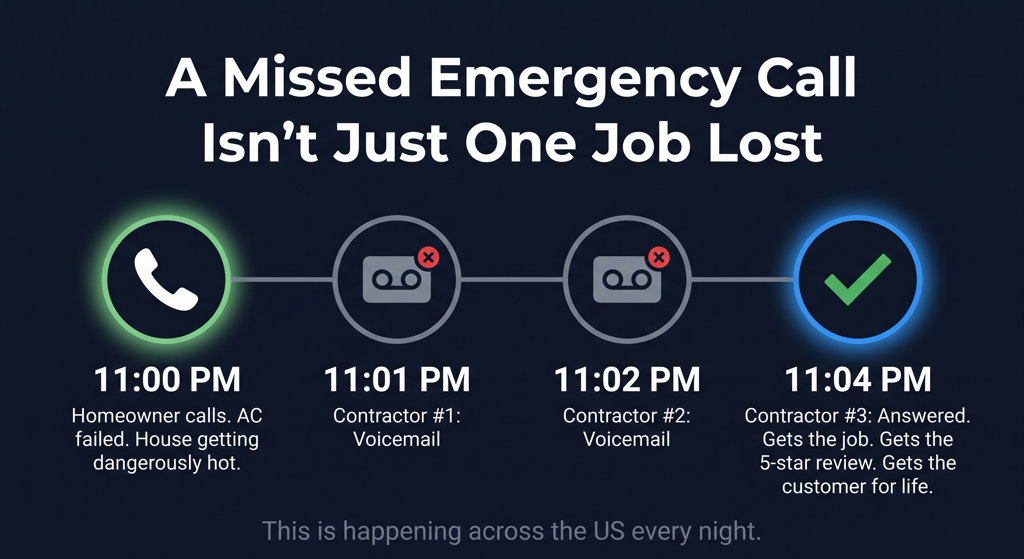
A homeowner whose heat has stopped working at 11pm in January, with an elderly parent in the house, who calls and gets voicemail, that’s a different situation entirely. They are not calling back tomorrow. They are calling the next contractor right now.
That’s the real cost of a missed HVAC emergency call. And it’s not just the job value.
What actually happens when an emergency call goes unanswered
When a homeowner faces a genuine HVAC emergency, their decision-making follows a predictable sequence.
They call the first contractor they find, usually whoever is at the top of their Google search, or the number saved from a previous service. If that call goes to voicemail, they don’t leave a message and wait. They immediately call the next number on the list. If that goes to voicemail too, they call a third.
The contractor who answers (whoever it is, at whatever price) gets the job. The other two never find out they lost it.
This is the single most important thing to understand about HVAC emergency calls: the market for an emergency job closes in minutes, not hours. A homeowner in a genuine emergency will not wait until morning for a callback. By the time you return a voicemail left at 11pm, they are already booked with someone else and their problem is being solved.
The missed call didn’t just cost you a service call. It gave a competitor a new customer.
The direct job value
A single HVAC emergency call represents real money. Depending on the issue and market, emergency service calls typically run $200–$600 for diagnostic and repair work. System replacements triggered by an emergency visit run $5,000–$15,000. Emergency pricing, which most contractors apply for after-hours calls, adds a 1.5x to 2x premium on top of standard rates.
In Phoenix during a July heatwave, an after-hours emergency call to repair or replace a failed AC unit is one of the highest-value interactions in HVAC. A customer who is panicking about their family’s comfort will not haggle over an after-hours premium. They want the problem solved.
That’s the job you lose when the call goes unanswered.
The lifetime value calculation
The direct job is only part of the picture. The harder number to see, but the more important one, is the lifetime value of the customer you didn’t acquire.
An HVAC customer who has a great emergency experience typically stays with that contractor for years. Annual maintenance plans, seasonal tune-ups, system upgrades, referrals to neighbours and family. The lifetime value of an HVAC customer over five years is often $2,000–$5,000, depending on the household and market.
When your competitor answers that 11pm emergency call and does an excellent job, they don’t just get the $400 service fee. They get the maintenance plan renewal next spring, the replacement quote when the system ages out, and the referral to the homeowner’s brother-in-law who mentions his AC has been making a strange noise.
You got nothing. Because the call went to voicemail.
Why emergency calls cluster at the worst moments for phone coverage
The frustrating reality of HVAC emergency calls is that they arrive precisely when your phone coverage is thinnest.
HVAC systems fail when they’re under maximum stress: during the first extreme heat of summer, during a January cold snap, during an unusual weather event. These are the same periods when your technicians are already stretched across maximum demand, when your dispatcher is handling a surge of routine calls, when everyone is too busy to answer the next incoming call.
Evening and overnight is when it’s worst. A system that has been struggling all day often fails completely around 6–9pm when the household load peaks. A family that has been tolerating a barely-functioning AC on a 105-degree day reaches crisis point after dinner when it gives out completely.
That 7pm call on a Friday during a Phoenix heatwave is both your most valuable emergency opportunity and the call most likely to hit voicemail.
The reputational cost that doesn’t show on any spreadsheet
There’s a third cost to missed emergency calls that contractors almost never quantify: the review they don’t get, or worse, the one they do get.
A homeowner who calls in a panic, gets voicemail, calls two more contractors, eventually gets someone to come at midnight, and solves the crisis, occasionally, they come back to the first contractor who didn’t answer and leave a review. Not a good one. “Called at 9pm when our AC died, went to voicemail. Had to find someone else. Very disappointing.”
That review sits on your Google listing. Every future customer who finds you during an emergency search sees it. The review doesn’t just record a lost job, it actively damages your ability to win the next one.
Conversely, the contractor who answers that call earns something money can’t easily replicate: a panicked family gets taken care of, and they tell people about it. “Our AC died at 10pm on the hottest day of the year. These guys answered immediately, sent someone within an hour, and had us back up by midnight. Five stars.” That’s the review that drives the next three calls.
What the fix looks like in practice
The solution to missed emergency calls isn’t hiring overnight staff. For most small HVAC shops, that’s economically unworkable, you’d be paying a full salary for coverage during hours that generate a fraction of your call volume.
The practical fix is a system that answers every call regardless of the hour, takes down what the caller is dealing with in their own words, and puts that in front of you instead of leaving it in a voicemail box until morning.
Thermoi’s AI assistant Sara answers that call. When a homeowner calls at 11pm, Sara asks what the system is doing and captures the answer in the homeowner’s own words, “no AC,” “no heat.” She takes the service address and the callback number, and books a time when there is one.
The homeowner gets heard, and gets told plainly what happens next. They don’t get voicemail. They don’t get “please call back during business hours.” And you get the whole call as a summary and a full transcript, so you are the one deciding who goes first.
That’s the difference between losing a $400 emergency job and a five-year customer relationship, versus capturing both.
A simple test
Think about the last three HVAC emergencies in your market, not yours specifically, but the ones happening right now in Phoenix or Houston on a hot evening, or anywhere else you serve. Three families with failed AC units, calling contractors.
How many of those calls are you answering? How many are going to voicemail? How many are ending up with a competitor who happened to pick up?
If you don’t know the answer to those questions with confidence, that’s the problem. The fastest way to find out is to run Thermoi free for a month. No card required, cancel anytime. It answers on your real phone line and you get full transcripts, so you can read every call that came in overnight. At day 30 you get a report, calls answered, appointments booked, recordings, and you either pick a plan or walk away owing nothing.