
For decades, the HVAC answering service was the standard solution to a simple problem: contractors can’t answer the phone when they’re on a job.
You’d pay a monthly fee to a service staffed by human operators. Calls would come in, the operator would take a message, and you’d call the customer back when you could. It wasn’t perfect, but it was better than voicemail.
In 2026, that model is being replaced. Not because the problem changed, contractors still can’t answer calls when they’re on jobs, but because the solution got dramatically better.
This post explains what’s changing, why the traditional answering service is losing ground in HVAC specifically, and what the practical difference looks like for a small shop.
What a traditional HVAC answering service actually does
It’s worth being honest about what answering services deliver, because the gap between what contractors expect and what they get is part of why the shift is happening.
A traditional answering service provides human operators who answer calls on your behalf, usually 24/7. The operator takes the caller’s name, phone number, and a brief description of why they called, then sends you a message, typically via SMS or email. You call the customer back.
That’s the core service. Some answering services offer scheduling integration, but it’s basic, they can add an appointment to a shared calendar, but the operator typically doesn’t have visibility into your actual technician availability, job durations, or dispatch priorities.
The pricing varies. Budget answering services charge $50–$150 per month for basic message-taking. More capable services with scheduling integration charge $200–$500 per month. Some charge per-minute or per-call rates on top of the base fee, which can add up significantly during peak season.
For many HVAC contractors, this has been a reasonable spend for a long time. The question is whether it’s still the right spend in 2026.
The three things traditional answering services can’t do
1. Give you the whole call, not a couple of lines about it.
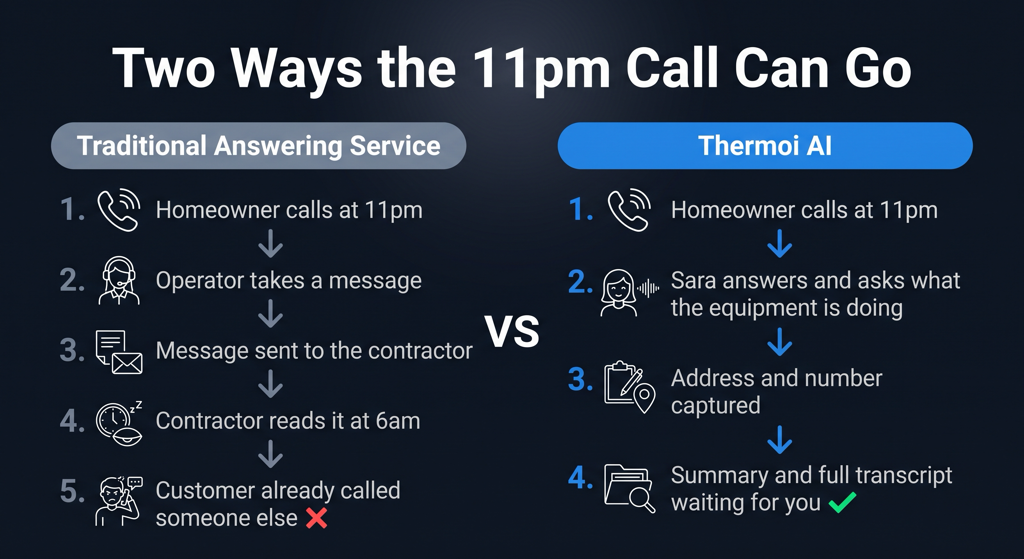
This is the biggest gap. When a homeowner calls at 11pm because their heat has stopped working in January, a traditional answering service operator takes a message. They might note “urgent” or “emergency” in the message. But what reaches you is a couple of lines written down second-hand: not what the unit is actually doing, not how long it has been doing it, not who is in the house. They send you a text, and you see it when you see it.
For a routine booking, that delay is acceptable. For a genuine emergency, it’s not. In a competitive HVAC market, the contractor who rings back first, already knowing what the problem is, gets the job. The contractor who reviews messages in the morning finds out they lost it the night before.
AI phone systems like Thermoi handle this differently. When Sara takes a call like that: no heat, no AC, mentions of vulnerable household members, a call after 9pm during extreme weather: she captures the address and the homeowner’s own words, and the whole call comes back to you as a summary and a full transcript when it ends. Nothing in the product decides for you which call is the emergency.
2. Book appointments without calling back.
Traditional answering services take messages. The callback is still on you. Every callback is a second interaction with a customer who has already waited, another chance for them to have found someone else, another task on a list that grows during busy periods.
AI phone assistants book appointments during the first call. The homeowner calls, explains what they need, and gets a confirmed appointment time before they hang up. No callback. No waiting. The appointment appears in the dashboard.
For routine bookings especially (tune-ups, filter changes, seasonal maintenance checks) there’s no reason this process requires a human callback. The information needed to book an appointment (address, contact, availability, job type) can be collected and confirmed in a single call.
3. Learn your business and improve over time.
A traditional answering service operator reads from a script you provide when you sign up. They handle calls according to that script. If your procedures change, you update the script. If your service area changes, you notify the service. The system doesn’t adapt.
AI phone systems are configured specifically for your business (your service area, your services, your greeting and your scheduling preferences) and they produce data from every call. Full transcripts, appointment details and call patterns all build up over time into operational intelligence you’ve never had before. Which call types are most common? What times do the after-hours calls come in? What questions do callers ask most often? That data exists now, accessible in a dashboard, and it improves how the system handles future calls.
Why this shift is happening now
The technology that makes AI phone assistants viable for HVAC didn’t exist five years ago. The combination of accurate speech recognition, natural language understanding capable of handling unscripted conversation, and low-latency voice synthesis has only become reliable enough for real business use in the past two to three years.
The practical result is that an AI phone system can now conduct a conversation that most callers won’t immediately identify as automated, not because it’s trying to deceive them, but because the quality of the interaction is high enough that the distinction doesn’t register in the way it used to with old IVR systems.
Callers who interacted with automated phone systems in 2018 learned to hate them. Press 1 for this, press 2 for that, please hold while we transfer your call. That experience trained a generation of people to distrust and resent phone automation.
The AI systems operating in 2026 are categorically different. They answer naturally, ask follow-up questions, handle interruptions, and respond to the actual content of what the caller says rather than forcing them into a decision tree. The barrier to adoption, customer experience, has dropped significantly.
What the economics look like
A traditional answering service in the $200–$400/month range provides 24/7 human coverage with basic message-taking and limited scheduling.
Thermoi starts at $299/month, with the first month free, and provides 24/7 AI coverage with real appointment booking, full call transcripts, email and Slack notification after every call, a dashboard showing every interaction, and Spanish-language capability.
At similar price points, the AI option delivers more functionality. That’s the simple version of the economic case.
The more important economics are on the revenue side. An answering service that takes messages reduces your missed call rate, callers reach a human instead of voicemail, which is meaningful. But if those calls still require a callback to convert to a booked appointment, you’re adding friction and delay into a process where your competitors may be answering and booking in a single call.
The contractors who win on call conversion in 2026 will be the ones who complete the booking during the first call, ring back their after-hours callers already knowing what was said, and have operational data to show them where their call handling is strong and where it’s leaking revenue.
What doesn’t change
AI phone systems don’t change the fundamental relationship between an HVAC contractor and their customers. They handle the structured, informational part of call interactions (what do you need, when can we come, here’s your confirmation) so that the human interactions that matter (the technician at the door, the owner following up after a job, the conversation about a system replacement) can happen without the administrative overhead that currently consumes too much of everyone’s time.
The on-call tech still goes to the job. The owner still makes the decisions about pricing and staffing. The relationship with the customer is still built through the quality of the work. What changes is the layer around all of that, the calls that come in at 10pm, the routine bookings that happen at noon on a Tuesday, the Spanish-speaking caller who needs to schedule a maintenance visit.
Those interactions get handled accurately, at any hour. Everything else stays the same.
The transition
Moving from a traditional answering service to an AI phone assistant doesn’t require a long implementation. Thermoi’s setup involves configuring Sara with your business information (service area, services, greeting and scheduling preferences).
The first month is free, which is the lowest-risk way to see the difference in practice. No card required, cancel anytime. Run both systems in parallel if you want, keep your answering service active and see how Sara handles calls alongside it. Sara runs on your real phone line and every call is transcribed, so at day 30 you get a report: how many calls came in, what types they were, how many appointments were booked, with the recordings to go with it.
That data will tell you more than any comparison article can. At the end of the month you either pick a plan, from $299 a month or pay per booked appointment, or walk away owing nothing.