
If you run an HVAC business, you’ve probably noticed more tools showing up that promise to “use AI” to fix your operations. Some of them are genuinely useful. A lot of them aren’t built for the way HVAC businesses actually work.
This guide covers what AI phone systems are, how they work in the context of an HVAC business specifically, what to look for when evaluating one, and where the real ROI comes from. No hype, just a practical breakdown from the contractor’s perspective.
What an AI phone system actually is
An AI phone system is software that answers inbound calls on your behalf, conducts a real conversation with the caller, and takes a defined action at the end: booking an appointment, sending a transcript, or routing to a human.
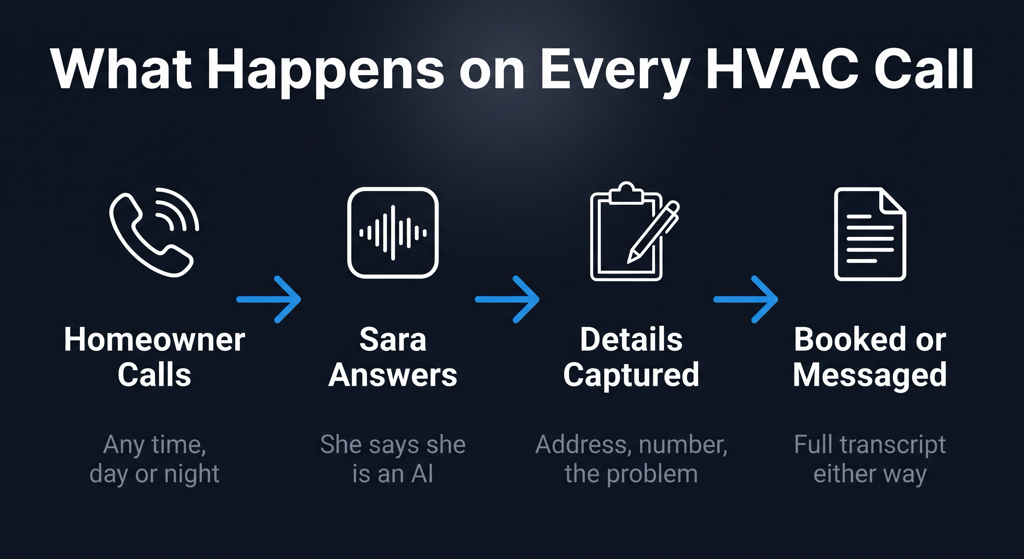
It’s not a voicemail system. It’s not a pre-recorded message tree. When a homeowner calls and says “my AC just stopped working and it’s 95 degrees in here,” a well-built AI phone system understands that sentence, asks sensible follow-up questions, books an appointment if there is one to book, and hands the whole conversation back to you in the caller’s own words.
The underlying technology is voice AI, the same category of technology powering tools like Siri, Alexa, and more recently, a generation of purpose-built business phone assistants. What makes modern voice AI meaningfully better than older systems is that it handles natural, unscripted conversation. Callers don’t have to press 1 for this and 2 for that. They just talk.
Why HVAC is a particularly good fit for AI phone systems
Not every business benefits equally from AI phone systems. HVAC does, for several specific reasons.
Call timing is unpredictable and urgent. Unlike a dentist’s office where appointments are scheduled weeks in advance, HVAC emergencies happen without warning, and they happen disproportionately at inconvenient times. A heat pump failure in January doesn’t wait for business hours. An AC breakdown in a Phoenix summer hits at 7pm on a Friday. These are the calls most likely to hit voicemail, and they’re the calls with the highest urgency and highest job value.
The first-to-answer wins. When a homeowner’s HVAC system fails, they don’t send one inquiry and wait. They call three contractors in a row and book with whoever picks up. The competitive dynamic in HVAC is immediate and winner-takes-all on each call. A contractor who answers 90% of calls captures jobs that their competitors never even know they lost.
There’s a clear, measurable ROI. A typical HVAC service call runs $200–$700. A system replacement is $5,000–$15,000. If an AI phone system captures two additional calls per week that would otherwise have gone to voicemail, the ROI is obvious and calculable, usually well under two months to break even at $299/month.
Emergency and routine calls need different handling. A homeowner asking about a spring tune-up can wait until morning. A homeowner with no AC and a baby in the house cannot. That judgement is yours to make, and you can only make it on the calls that actually reach you. The point of answering every one is that both homeowners end up in front of you, in their own words, instead of the second one becoming a voicemail you find on Monday.
How an AI phone system works on a real HVAC call
Here’s what happens on a typical inbound call handled by Thermoi’s AI assistant, Sara.
A homeowner calls at 9:47pm. Their upstairs AC unit stopped blowing cold air three hours ago. Sara answers. She introduces herself as an AI assistant calling on behalf of the HVAC company, asks what the issue is, and listens. The homeowner explains the problem. Sara asks a few follow-up questions, how long it’s been down, whether it’s making any unusual sounds, whether anyone in the house has medical needs that make heat particularly dangerous.
Sara does not decide whether this counts as an emergency, and she does not promise that a technician is on the way. She captures the address, confirms the contact number, takes the homeowner’s own description of what the equipment is doing, and sends a full transcript to the contractor’s dashboard.
The contractor’s dashboard shows the full call record with the AI’s summary of the situation, and an email or Slack notification goes out once the call ends if those are switched on. Which call gets someone first stays the contractor’s decision, made from the transcript.
That’s one call that would have hit voicemail without a system like this. Depending on the urgency, that’s a $300–$500 service call or the beginning of a system replacement conversation.
What to look for when evaluating an AI phone system for HVAC
Not all AI phone systems are built the same. Here’s what matters specifically for HVAC:
Enough detail to judge urgency yourself. You are the one who decides whether a call is an emergency, and you can only do that from what the caller actually said, “no heat,” “no AC,” a mention of a baby or an elderly parent in the house. Look for a system that captures the homeowner’s own description of the fault alongside the address and a callback number, rather than one that hands you a one-line note saying somebody rang.
Natural conversation handling. Homeowners don’t speak in structured sentences. They ramble, backtrack, and describe problems in non-technical terms. The AI needs to extract the relevant information without making them feel like they’re filling in a form. If the system requires callers to respond in specific phrases, it will frustrate people and hurt your reputation.
Appointment booking integration. Capturing information is only half the job. The system should book the appointment directly into your calendar, not just send you a message saying someone called. Thermoi’s Sara books appointments into your Thermoi dashboard, complete with customer details and the AI’s summary of the call. Writing them into an external calendar is on the roadmap, not in the product today.
Full call transcripts. Every call should produce a written record. This matters for two reasons: first, you can review any call where something went wrong and understand exactly what happened. Second, the transcript data builds up over time into a picture of your most common call types, objections, and customer pain points.
Bilingual capability. In Phoenix and across much of the US southwest, Spanish-speaking callers represent a significant portion of the market. An AI system that can handle Spanish-language calls without switching to a different mode or failing mid-conversation is a meaningful advantage.
White-label capability. The best systems answer as your company, not as a generic AI service. When Sara answers a call for Smith’s Heating and Cooling, she introduces herself as being with Smith’s Heating and Cooling. Callers don’t know they’re talking to an AI unless they ask.
What AI phone systems don’t do (yet)
Being clear about limitations matters.
Current AI phone systems are designed for inbound call handling: answering calls, gathering information, and booking appointments. They’re not yet capable of handling complex diagnostic conversations (a homeowner trying to troubleshoot a problem live), nuanced negotiation (a customer pushing back hard on pricing), or situations that require genuine human judgment about ambiguous circumstances.
The right way to think about them is as a highly capable first point of contact. They handle the structured part of the call (capturing information, booking the appointment) and hand off anything that needs a human to a human.
For most HVAC contractors, this covers 80–90% of inbound calls entirely, and gives the remaining 10–20% a much better first experience than voicemail.
The setup process
One of the common objections to AI phone systems is complexity, contractors assume integration will take weeks and require an IT person.
For Thermoi, the setup process is straightforward. You provide your business information and how you want the phone answered. Sara is configured to represent your company specifically: your name, your service area and your greeting.
The first month is free. No card required, cancel anytime. Sara runs on your real phone line for the whole month, with full transcripts, so you can see how she handles actual calls before committing to anything. At day 30 you get a report covering calls answered, appointments booked and the recordings, and you either pick a plan or walk away owing nothing. After the free month there are two paid paths: a monthly plan from $299, or pay per booked appointment.
The question worth asking yourself
Before spending more on ads, hiring a part-time receptionist, or upgrading your answering service, it’s worth asking a simpler question: what percentage of calls that come into your business right now are actually being answered?
If the honest answer is anything below 85–90% (accounting for evenings, weekends, busy periods when all your techs are on jobs) then an AI phone system is the highest-ROI investment available to you. It doesn’t generate new leads. It captures the leads you’re already paying for but currently losing.
That’s the real value of a voice AI for HVAC. Not magic. Just never missing a call again.