
It’s 9pm on a Friday in July. A homeowner’s AC just stopped working in Phoenix. The temperature inside is already 85°F and climbing. They have two kids and an elderly parent in the house.
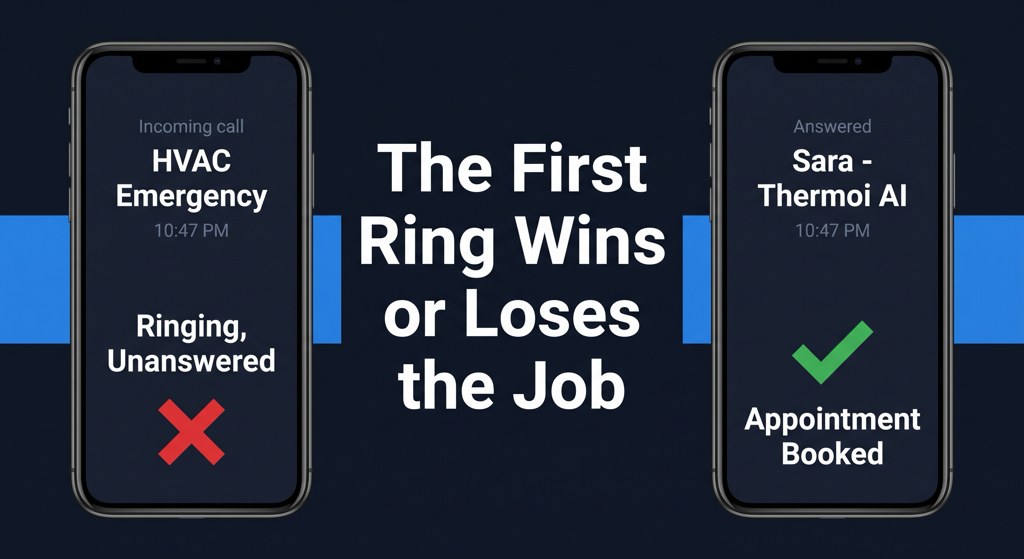
They pick up their phone and search “HVAC emergency repair Phoenix.” They find three contractors with decent Google ratings. They call the first one.
Voicemail.
They call the second one.
Voicemail.
They call the third one, and someone answers.
That third contractor just won a $400–700 emergency job. Not because of their price, not because of their reviews, not because of their truck wraps. Because they answered.
This is where HVAC customer experience actually starts: not when the technician shows up, not when the invoice is sent, but the moment the phone rings.
The Missed Call Is the Missed Moment
Most HVAC contractors think about customer experience in terms of job quality, technician professionalism, and pricing. Those things matter enormously, but they only come into play if the customer reaches you first.
The research tells a painful story:
A typical small HVAC shop misses 5 to 15 calls per week. At an average job value of $400 to $700, that’s $2,000 to $10,000 in potential revenue walking out the door every single week. Most of it goes to whoever picks up the phone.
After-hours and weekends are when it hurts most. That’s exactly when emergencies happen, when a family’s heat goes out on a December night, when an AC fails in the middle of a Phoenix heatwave. Those are high-urgency, high-value calls. And they’re the ones most likely to hit voicemail.
The first 10 seconds of a call shapes everything that follows: whether they book with you or your competitor, how professional they think you are, whether they ever call you again.
What Happens Inside an HVAC Emergency Call
To understand why phone experience matters so much in HVAC specifically, it helps to understand what a homeowner is actually feeling when they call.
They’re not comparison shopping. They’re stressed. Their comfort system has failed, often at the worst possible time, and they need someone to take control of the situation. What they want to hear in the first 30 seconds is:
- Someone answered
- They understand the problem
- They know what to do about it
- Help is coming
What they don’t want is to leave a message, wait for a callback that may never come, or repeat their address and problem to three different people.
The Air-Rite demo, a real call session run through Thermoi’s AI, showed this in practice. A homeowner calls at 10pm reporting a complete AC failure. The call is answered. Sara asks what the equipment is doing, takes down the homeowner’s own words for the fault, and captures the service address and a callback number. Nobody is asked to leave a message, and the whole call comes back to the contractor afterwards as a summary and a full transcript. The homeowner’s stress level drops. They feel taken care of.
That’s customer experience. Not a form to fill in, not a callback promise, but a conversation in which somebody takes the details down and the homeowner knows they have been heard.
The After-Hours Gap Most Contractors Don’t Know They Have
A customer calling to schedule a routine spring AC tune-up can wait until Monday. A customer calling at 11pm because their elderly mother’s heat has stopped working cannot.
The distinction matters enormously to your customers. A homeowner in a genuine emergency who gets told “someone will call you back in the morning” does not feel cared for. They feel abandoned. They hang up and call the next contractor.
Which of those two calls gets seen to first is settled by your own out-of-hours process, not by software. It is worth an hour of anyone’s time to look at that process honestly: who reads the overnight calls, when they read them, and what the rota does about the ones that will not keep until the morning. Most shops have never sat down and worked it out.
What a phone system can do is give you something to work from. Voicemail gives you a light on a handset. Most answering services give you a message: a name, a number and a line about the problem. A full transcript gives you the call as the homeowner told it: no heat, elderly mother in the house, 11pm. That is what the decision turns on.
What you do with that call determines whether the customer books with you, leaves you a 5-star review, and refers their neighbour.
Why Consistency Beats Heroics
The best HVAC contractors build reputations on reliability, not occasional excellence but consistent, predictable quality every single time a customer calls.
Human answering has inherent inconsistency. Your dispatcher is excellent on a Tuesday morning and overwhelmed on a Saturday afternoon during peak season. Your on-call tech answers professionally most of the time but occasionally sounds half-asleep at 2am. These are human realities. They’re understandable. But they create variance in the customer experience that damages your brand in ways you often don’t see until a review appears.
AI phone systems like Thermoi’s Sara don’t have bad days. The 2am call gets the same professional, unhurried, knowledgeable response as the 10am call. During peak season when your call volume triples, the 15th call of the day sounds exactly like the first.
Consistency isn’t glamorous. But it’s what builds the kind of reputation that fills your schedule without paid advertising.
The Metrics That Actually Tell You How Your Phone Experience Is Performing
Most HVAC contractors have no idea how their phone experience is actually performing. They know their Google rating but not their call answer rate. Here are four numbers worth tracking:
Answer rate: What percentage of incoming calls are answered live, not by voicemail, not by an answering service that takes a message? For most contractors without an AI system, this is well below 80% when you account for after-hours, peak periods, and times when everyone is on a job.
Voicemail-to-callback conversion: Of customers who leave a voicemail, how many actually convert to a booked appointment? The data is not encouraging, most don’t wait.
After-hours follow-through: Of the calls that come in overnight and at weekends, how many did your own out-of-hours process act on before the next working day? Nearly impossible to measure without call transcripts, and most shops have never counted.
Review correlation: Compare your Google reviews that mention “easy to reach,” “answered right away,” or “quick response” against periods when your call handling was stronger. The correlation is almost always there.
Thermoi’s dashboard gives HVAC contractors visibility into all of these: every call logged, every transcript available, every appointment created by the AI visible in one place. It’s the operational data most contractors have never had access to before.
What This Looks Like in Practice
The shift from “hope someone answers” to “every call handled professionally” is simpler than most contractors expect.
Thermoi’s AI assistant, Sara, answers every inbound call 24/7. She introduces herself as an AI calling on behalf of your business, asks what the customer needs, captures their address and equipment details, and books the appointment when there is one. Every call gets a full transcript. Every appointment shows up in the dashboard.
For contractors already running an answering service, Thermoi isn’t a replacement, it’s a layer of intelligence on top of what you already have. For contractors currently relying on voicemail and callbacks, it’s the difference between capturing those 10pm Friday calls and losing them.
The first month is free. No card required, cancel any time. Sara runs on your real phone line and every call is transcribed. At day 30 you get a report of calls answered, appointments booked and recordings, then you either pick a plan or walk away owing nothing. After that it’s a monthly plan from $299, or you pay per booked appointment.
The Bottom Line
Customer experience in HVAC doesn’t start when your technician arrives at the door. It starts when the phone rings: at 2pm on a weekday, at 10pm on a Friday, at 6am on a January morning when a family wakes up to no heat.
The contractors who win on customer experience aren’t just doing better work. They’re answering the phone when others don’t. They’re giving homeowners the clarity and confidence they need in a stressful moment.
That’s what a great phone system delivers. And in a market where the first contractor to answer usually wins the job, it’s not a nice-to-have. It’s the whole game.